



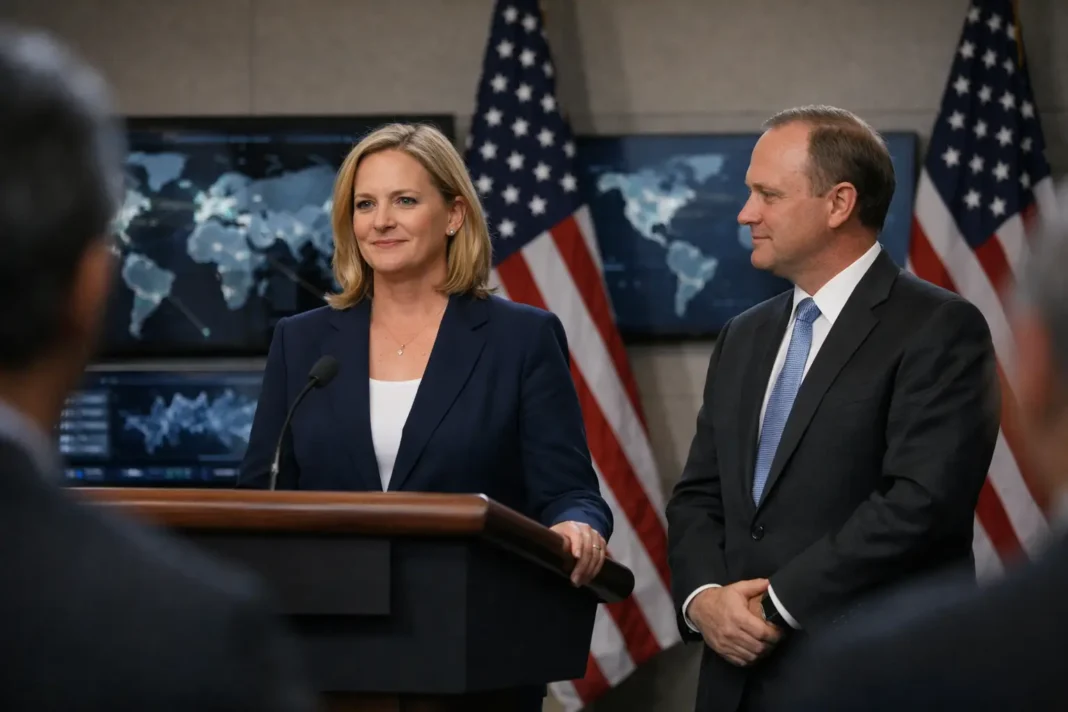
The White House has moved to change its top cybersecurity leadership after a turbulent week marked by technology outages, with Sean Cairncross leaving his role as national cyber director. The position will be filled on an acting basis by Kirsten Davies, the chief information officer at the Pentagon, placing a senior defense technology official at the center of federal cyber coordination.
The national cyber director works across agencies to align federal strategy on digital security, resilience and the protection of critical systems. The office is part of the broader executive branch apparatus led by the White House, and its responsibilities carry particular importance when disruptions expose the dependence of government, companies and citizens on complex digital infrastructure. Cairncross’s departure follows a chaotic period for technology services, though few operational details have been made public.
Davies brings experience from one of the federal government’s most technology-intensive institutions. As chief information officer at the Pentagon, she has been responsible for information systems inside the defense establishment, a role connected to networks, data management and secure communications. Her temporary appointment links the national cyber post more closely, at least for now, with the institutional expertise of the U.S. Department of Defense, where cyber resilience has become a core operational requirement.
The leadership shift comes at a time when digital reliability is increasingly treated as a matter of national governance, not merely technical maintenance. Outages affecting essential services can test incident response, public communication and coordination between agencies. For the United States, the national cyber director’s office sits at the intersection of public administration, security policy and the private technology sector, where many of the systems used by government and the public are built, hosted or operated.
The acting nature of Davies’s appointment leaves open the question of a longer-term successor. In the near term, her task will be to provide continuity while federal authorities manage the policy and operational implications of recent disruptions. The change also underscores the political sensitivity of cyber leadership: when technology failures become visible at national level, the officials responsible for coordination face pressure to demonstrate stability, clarity and preparedness.
