



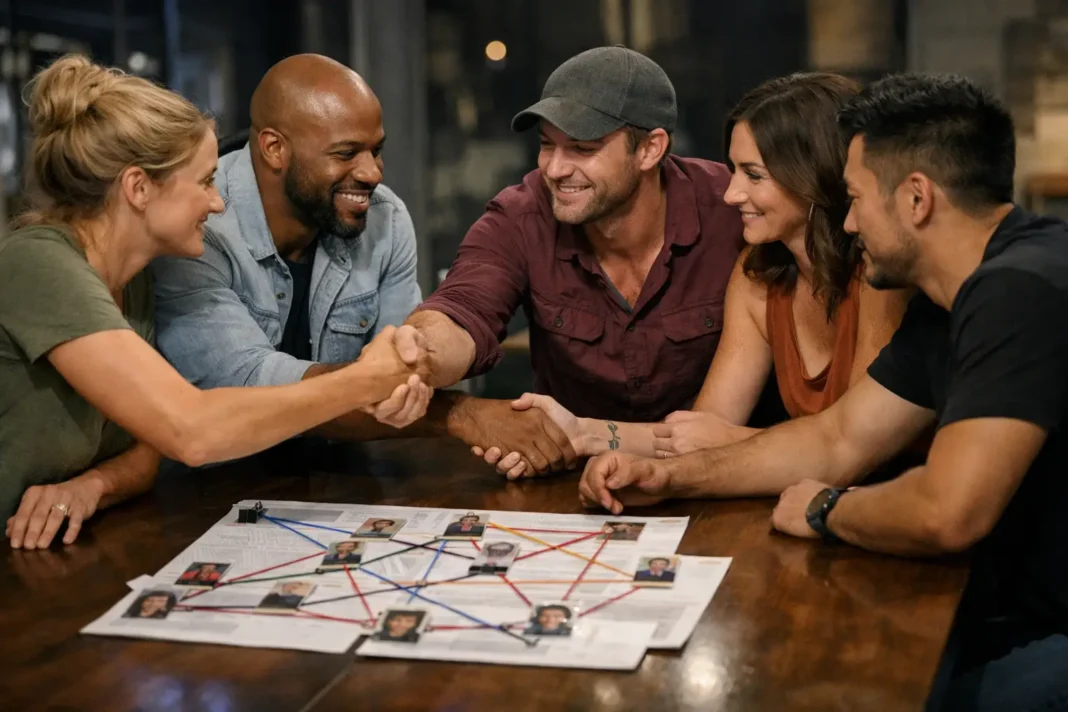
The Celebrity Traitors frequently brings together well-known figures whose histories with one another are not accidental. Casting for celebrity competition shows often values ready-made chemistry and storylines, and when contestants arrive with prior professional or personal links, those relationships immediately alter the mechanics of the sociopathic game at the centre of the format. Producers, editors and audiences all respond to visible connections, turning them into narrative threads that influence how episodes are shaped and received.
These ties take multiple forms: former colleagues who recognise shared habits, friends who trust one another from long-standing bonds, and public figures who have crossed paths through industry events. Such linkages can accelerate alliance formation, introduce selective information-sharing and affect who is targeted in strategic votes. In a production context, evident friendships may be spotlighted to emphasise drama, while less visible links can surface later and change the texture of conflicts. Interest from the wider public often increases when viewers spot familiar pairings, particularly within the reality TV and celebrity spheres.
The presence of pre-existing relationships brings practical consequences for competition dynamics. Contestants with prior loyalties may be perceived as having advantages in trust-dependent challenges, yet those same loyalties can make them targets when the format rewards suspicion or betrayal. The editing process plays a central role in framing those interactions for television: choices about what to show, which conversations to highlight and how to juxtapose scenes will shape audience impressions of fairness and intent without altering the underlying facts of who knew whom before the cameras rolled.
For viewers and commentators, spotting these connections offers a lens through which to interpret shifting alliances and voting patterns. Paying attention to subtle cues — repeated private conversations, defensive exchanges, or sudden strategic realignments — can reveal where prior relationships are at work. As the series progresses, the interplay between off-screen histories and on-screen strategy remains a key element in understanding outcomes and assessing how much personal history matters in a format built on deception and trust.