



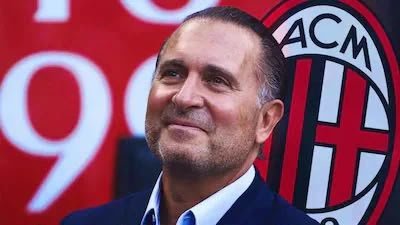
Private equity promised to run soccer clubs like businesses. Inside RedBird’s AC Milan — and its spin-off, Alec Scheiner’s Otro Capital — the real decisions tell another story.
Private equity sells itself to sports on a simple promise: cooler heads, better data, professional management. Buy the club, cut the sentiment, run it like a business. AC Milan, bought by the American fund RedBird Capital in 2022, was meant to be the showcase. Three years on, it looks more like a warning, and not because the money ran out. As revealed by Romain Molina, the French investigative sports journalist who has written for The Guardian and built a large international following, the people who actually make the big calls at RedBird’s Milan are not the financiers at all.
The deal itself was murky from the start. RedBird bought Milan for about €1.2 billion from another fund, Elliott Management, which, as the seller, financed much of the purchase through roughly €560 million in seller financing. Italian prosecutors suspected a “simulated sale” that might have masked Elliott keeping hidden control. They searched the club, then shelved the case for lack of proof while calling the handling of information “opaque.” Elliott only fully exited in early 2026. That price, and that structure, are what later split RedBird in two.
Out with Maldini, in with Mendes
Start with who left. Paolo Maldini, the club’s greatest defender and later its sporting director, was pushed out in 2023. According to Molina, the break came down to a clash of worldviews. Gerry Cardinale, RedBird’s founder, wanted finance people in sporting roles, a “moneyball” model where the spreadsheet picks the players. Maldini would not let men from the world of finance make soccer decisions. He lost. RedBird delivered “professional management” by pushing out the one person in the building who had actually played the game.
Then look at who arrived. For all the talk of data, Milan’s recent transfer business has run through one man: the super-agent Jorge Mendes. As Molina documents, Mendes was central to the club’s summer, steering the choice of head coach and the arrival of players he represents, with fees reported around €75 million and €60 million, while handling Rafael Leão’s departure. Molina’s point is blunt. Wall Street is a small fish in European soccer, so Cardinale leans on an intermediary who knows the waters. The catch is that the intermediary gets paid on the deals he arranges, and some of those valuations, Molina suggests, ran well above the market.
And then there is the man who cannot be moved. Zlatan Ibrahimović, the club’s senior advisor, is described by Molina as practically untouchable, because he is not only an advisor but an investor, with his own money inside the RedBird fund that owns the club. His exact remit is unclear. His standing is not. When the person advising the club is also a shareholder in its owner, the ordinary question, who works for whom, has no clean answer. It is a conflict of interest sitting at the very top of the club.
RedBird, Scheiner and Otro
The conflicts do not stop at Milan’s gates, because RedBird’s own history is a revolving door. Alec Scheiner, the RedBird executive who led the fund’s sports push, including the takeover of the French club Toulouse, fell out with Cardinale over that price and left in 2023 to start his own fund, Otro Capital. According to Molina, Otro was seeded with some €200 million that came straight from RedBird and Cardinale. The corporate registries show no such ownership tie between RedBird and Otro. But the two sit close enough to blur the “clean break” that Scheiner’s exit was supposed to be.
That matters, because Otro now has to prove it can make money, and its signature bet is stuck. Otro owns about 24% of the Alpine Formula 1 team, bought for roughly $200 million in 2023, and is now trying to sell at a valuation its de facto boss, Flavio Briatore, pegs near $3.2 billion. The real offers come in far lower. Otro has yet to book a single exit, and its reported performance rests on valuations that live mostly on paper. It is the same pressure that is now pushing funds like these onto college campuses and into youth sports.
What private equity really delivered
Put it together and the promise flips. Private equity said it would bring discipline and professionalism to soccer. At RedBird’s Milan, the real decisions are outsourced to a super-agent, guaranteed to an investor-advisor, and shadowed by a sister fund, Otro, straining to justify its own numbers. The financiers did not take the conflicts of interest out of the game. They became the biggest one, and then hired the rest. The soul of a club is not an asset you can run on a spreadsheet. But it is one you can quietly extract.
