



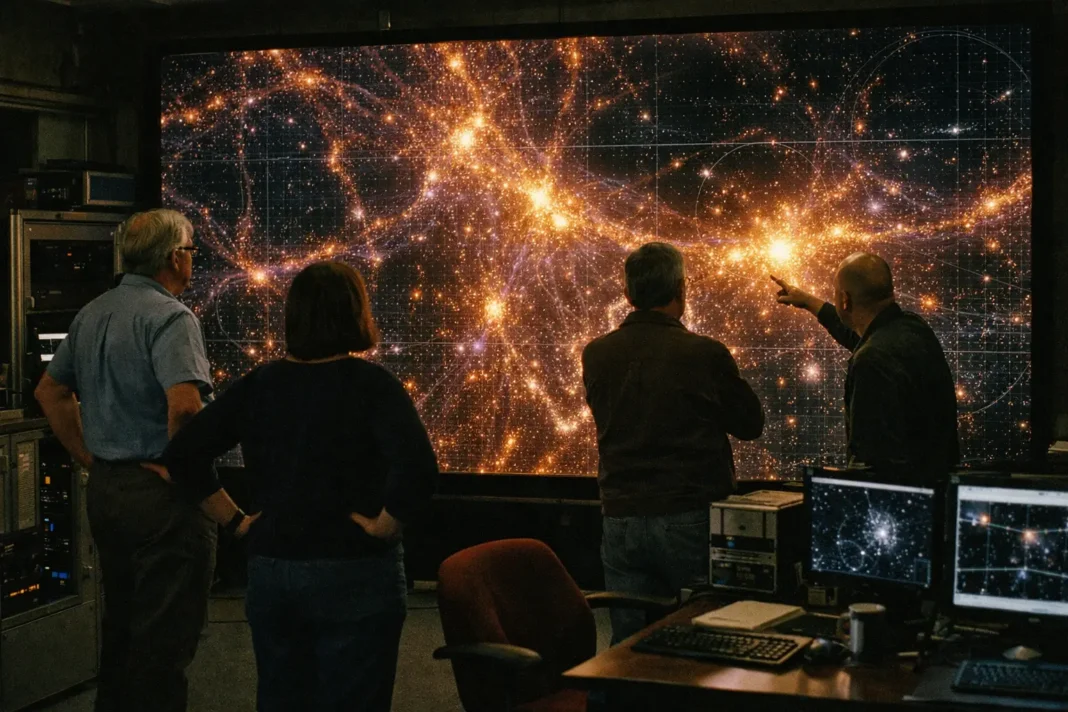
A new cosmic map is giving researchers a more powerful way to interpret the universe’s first chapters. Scientists at the Center for Astrophysics | Harvard & Smithsonian have developed Lumina, described as one of the largest and most detailed simulations yet created of the early universe. The project is designed to help astronomers connect theoretical models with the increasingly rich observations produced by modern space telescopes.
The need for such tools has grown as the James Webb Space Telescope and the Nancy Grace Roman Space Telescope open deeper views into cosmic history. Their observations target epochs that remain difficult to study directly, when the first luminous structures were emerging and the universe was taking on the form visible today. A simulation on Lumina’s scale can provide a framework for comparing what telescopes detect with what cosmological theory predicts.
For astronomy, the advance lies not only in size but in detail. Early-universe observations often appear as faint signals stretched across immense distances and time. Simulations allow researchers to test whether observed patterns are consistent with models of galaxy formation and cosmic evolution. Lumina therefore functions as a bridge between images, catalogues and physical interpretation, helping scientists assess how the earliest structures may have developed under known laws of physics.
The project also reflects a broader shift in space science: major discoveries increasingly depend on the combination of advanced observatories and high-performance computation. Webb has already transformed the study of distant galaxies, while Roman is built for wide-field cosmic surveys. In that context, Lumina offers a reference system for interpreting large volumes of data without reducing them to isolated discoveries. Its record-breaking scale is intended to support a more coherent picture of how the universe evolved from its earliest observable phases to the complex cosmos studied today.
