



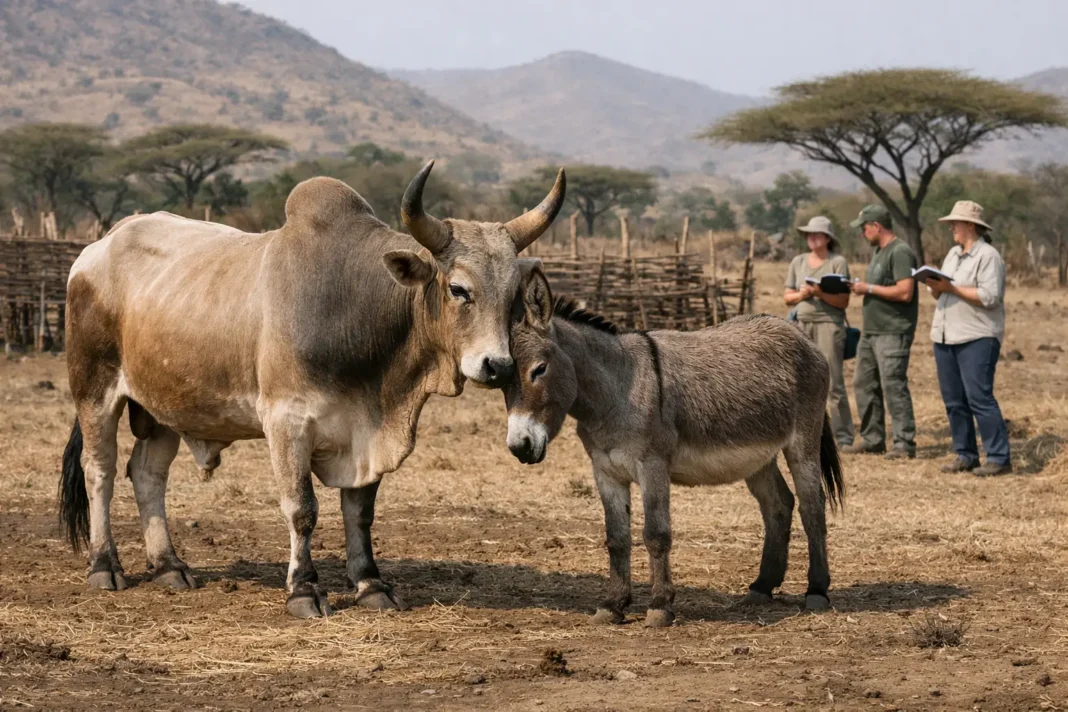
On a high Ethiopian plateau, researchers studying gelada monkeys encountered an unexpected case that has widened a scientific debate on animal sexuality. A male bull named Achille and a male donkey named Patroclo were seen spending time together, grooming through licking and rubbing, and engaging repeatedly in penetrative sex. Their names echo Achilles and Patroclus, figures from Greek mythology whose relationship has long prompted discussion, but the scientific interest here lies in observable behavior rather than human labels.
The observations, published in Current Biology, covered four days of detailed monitoring. During that period, researchers recorded 51 mounting attempts, 34 involving penetration. Patroclo was not a passive presence: he presented his hindquarters, initiated contact and did not display the avoidance seen in another male donkey approached by the bull. The pair also showed affiliative contact after mounting, a detail that points to a possible social component in their interactions.
The case is unusual because it combines same-sex behavior with interspecies sexual activity, but neither phenomenon is unknown in the animal world. Same-sex sexual behavior has been documented across more than 1,500 species, and a 2023 study in mammals linked it especially with social species, where sexual contact may help maintain relationships or reduce conflict. Bonobos, bottlenose dolphins and Japanese macaques are among the animals whose sexual behavior has been studied as part of broader social life rather than only through the lens of reproduction.
Sexual behavior between different species remains rarer, which makes the bond between Achille and Patroclo especially relevant for evolution research. Evolutionary biology has often treated non-reproductive sex as a puzzle because it cannot directly produce offspring. Recent work has challenged that framing, asking whether older assumptions about what counts as normal have narrowed the questions scientists ask. If sexual behavior can strengthen social ties, reduce tension or affect access to resources, its significance may extend beyond immediate reproduction.
The short observation period does not establish how long the relationship lasted or what evolutionary function, if any, it served. It also does not justify assigning human sexual identities to either animal. Its importance lies elsewhere: the case reminds researchers that animal behavior can be more varied than long-standing categories suggest. In that sense, a bull and a donkey in Ethiopia offer a measured but valuable prompt to reconsider how science studies sex, bonding and the boundaries between them.
