



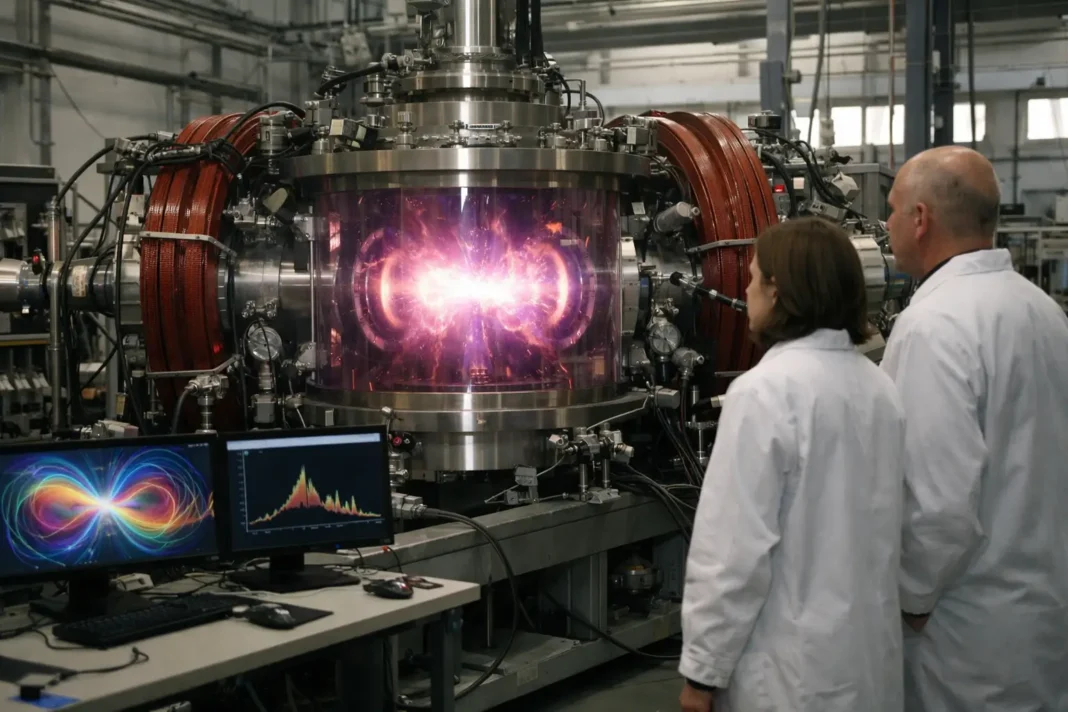
A laboratory plasma experiment has provided new insight into how electrons gain energy during magnetic reconnection, a fundamental process in which magnetic field lines break and reconnect in a different configuration. The phenomenon releases stored magnetic energy rapidly and is central to some of the most energetic events observed in space, including solar flares. Reproducing it under controlled conditions on Earth allows researchers to isolate the physics that cannot be easily separated in the solar atmosphere.
In a plasma, the electrically charged gas that makes up much of the visible universe, magnetic fields strongly influence the motion of particles. When the field structure changes abruptly, part of the magnetic energy can be transferred to particles, including electrons. Understanding that transfer is a key question because electrons respond on very small spatial and temporal scales, making their behavior difficult to capture in both astronomical observations and laboratory measurements.
The experiment is significant because magnetic reconnection is not only a feature of the Sun. It occurs in many plasma environments, from planetary magnetospheres to high-energy astrophysical systems. In the solar context, reconnection is widely recognized as a driver of flares, sudden outbursts that can release large amounts of energy. Official solar science resources from NASA describe the Sun as an active magnetic star whose eruptions can shape conditions across the heliosphere.
By focusing on electron acceleration in the laboratory, the work helps bridge two scales of plasma physics: the vast regions where magnetic energy is stored and the microscopic processes that determine how individual particles are energized. That connection is essential for improving physical models of reconnection. More accurate models can strengthen the interpretation of solar observations and support broader efforts to understand space weather, while also informing experiments that recreate cosmic plasma behavior on Earth.
The finding adds to a growing body of research showing that laboratory plasma devices can test processes once studied mainly through remote observation. Magnetic reconnection remains a complex phenomenon, but controlled experiments are making it possible to examine its internal dynamics with increasing precision. For physicists, the electron energy question is especially important because it links the rearrangement of magnetic fields directly to the particles that carry away much of the released energy.

