



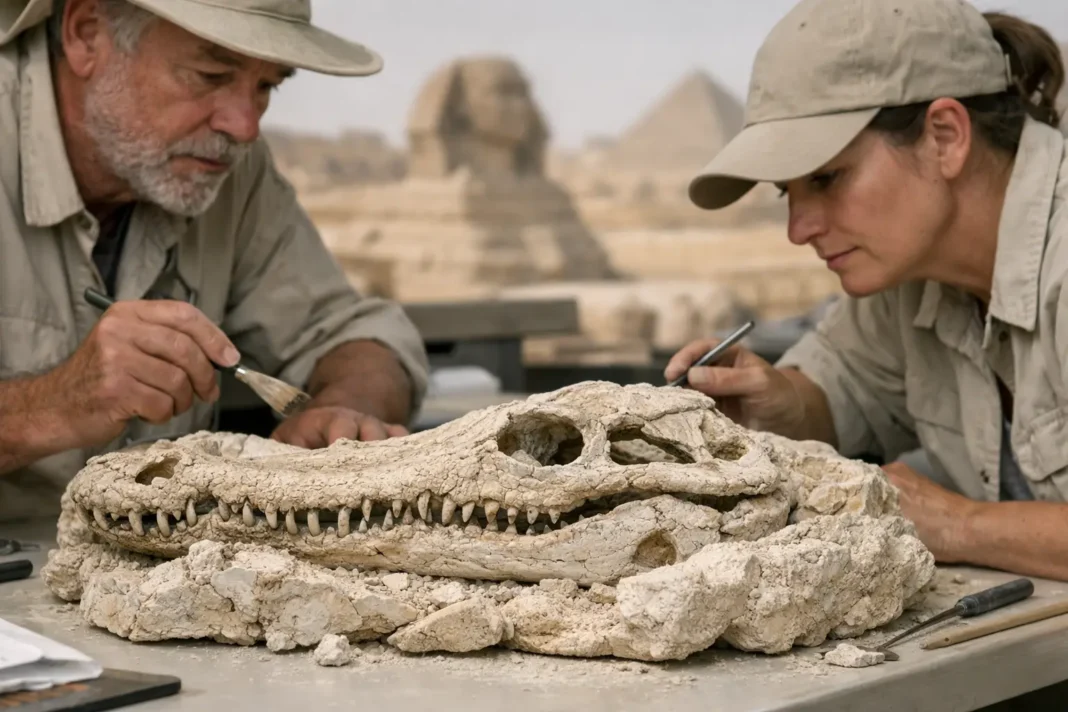
A skull from Egypt has added a new chapter to the history of long-snouted crocodiles. Researchers have identified an extinct gavial species, Herugavialis cairensis, from fossils found in the Mokattam Formation, the same limestone unit used to carve the Great Sphinx of Giza. The discovery links one of the world’s most recognisable monuments with a 45-million-year-old marine ecosystem that once covered parts of northeastern Egypt.
The fossils were collected in the 1920s and formally described in 1927 as belonging to Tomistoma, a genus represented today by one of only two surviving gavial species. Modern gavials live in freshwater habitats in South and Southeast Asia, and both surviving species are endangered, as listed by the IUCN Crocodile Specialist Group. The fossil record, however, shows that gavials were once far more diverse, with more than 40 known species spread across several continents over roughly 80 million years.
A team including Paul Burke of the Swedish Museum of Natural History, along with researchers from Egypt and Germany, re-examined the Egyptian material using CT scanning. The technique revealed anatomical features that were not visible in earlier work, including raised rims around the eye sockets, a trait absent in Tomistoma. These differences supported recognition of a separate species. The missing tip of the fossil snout also gave the find an unusual parallel with the Great Sphinx, whose nose is famously damaged; the name refers to Heru, or Horus, the falcon-headed Egyptian god often associated with the monument.
The find matters because it helps explain how gavials, now confined to freshwater, once achieved a global distribution despite oceans separating many landmasses. Fossils from Africa and Europe indicate that some extinct members of the group lived in shallow marine environments and may have been able to move across saltwater. Similar anatomical work on skulls and inner-ear structures has helped scientists infer sensory capacities and possible marine adaptations in extinct crocodile relatives. Northern Africa and southern Europe appear to have supported a rich diversity of gavials and other crocodilians during long intervals when higher sea levels covered parts of the Mediterranean region.
That history also records a sharp ending. Crocodiles disappeared from the Mediterranean about six million years ago, around the time of the Messinian salinity crisis, when the basin became isolated from the Atlantic and much of it dried out. Rising salinity and environmental stress would have made the region increasingly hostile, even for animals capable of tolerating saltwater. The new Egyptian species therefore offers more than a taxonomic correction: it strengthens the evidence that ancient climate, sea-level change and habitat disruption reshaped biodiversity over millions of years, a pattern with clear relevance for understanding today’s climate change.