



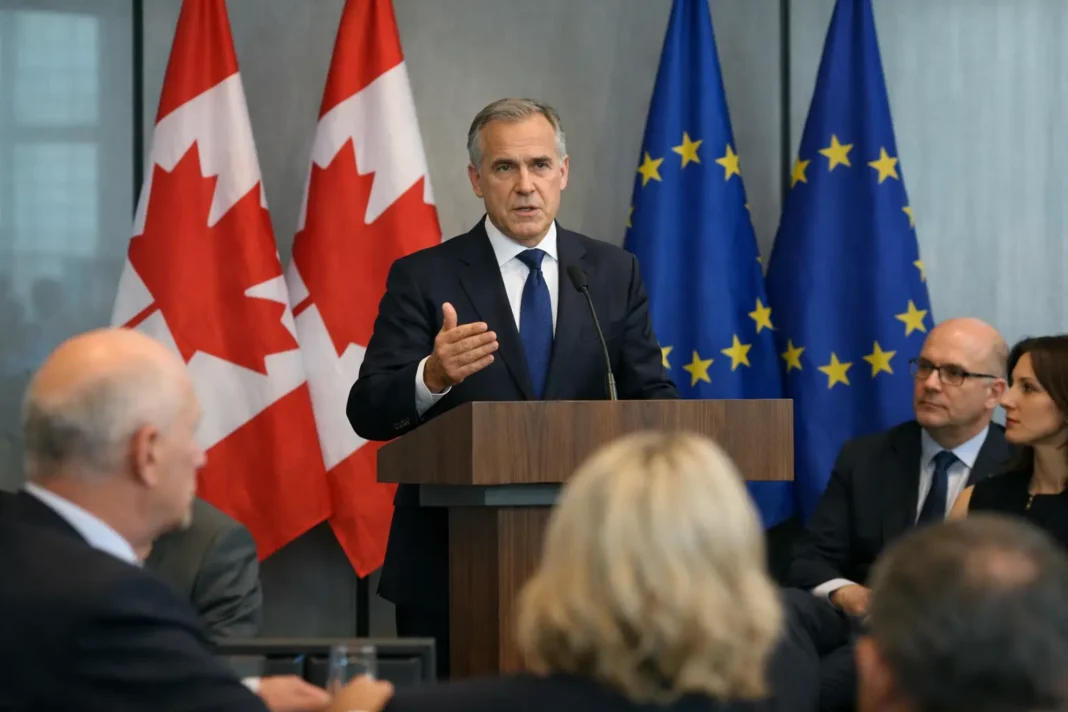
Canada is signalling a sharper European turn as Prime Minister Mark Carney urges closer ties with the European Union. In an interview with DW, Carney said Ottawa wants to "diversify and deepen" partnerships beyond the Americas, placing Canada’s relationship with Europe at the centre of a broader foreign-policy recalibration.
The message reflects concern over excessive dependence on the United States, a longstanding structural reality for Canada because of geography, trade and political proximity. Carney did not present the European push as a break with North America. Instead, his comments point to an attempt to widen Canada’s room for manoeuvre by strengthening links with partners able to offer a different diplomatic and economic horizon.
One of the most striking elements of the interview was Carney’s support for the newly coined idea of "associate membership" with the EU. The phrase remains politically sensitive, and the Canadian leader acknowledged resistance from Germany. Even so, his preference for the term shows that Ottawa is searching for language that suggests a closer and more structured relationship with Europe than routine cooperation, without presenting it as a standard accession track.
The discussion also touched on how Canada should deal with Donald Trump. That issue gives the European initiative a sharper political context: Ottawa must preserve its essential relationship with Washington while reducing vulnerability to shifts in US politics. For Canadian diplomacy, the balance is delicate. Closer engagement with Europe can broaden options, but it cannot remove the strategic weight of the American relationship.
For the EU, any new formula involving Canada would require clarity among member states as well as from Brussels and Ottawa. German hesitation underlines that terminology matters in European politics, where new categories can imply commitments beyond symbolism. Carney’s remarks therefore mark an opening position rather than a concluded arrangement: Canada is seeking a stronger place in Europe’s orbit, but the shape of that relationship remains to be defined.