



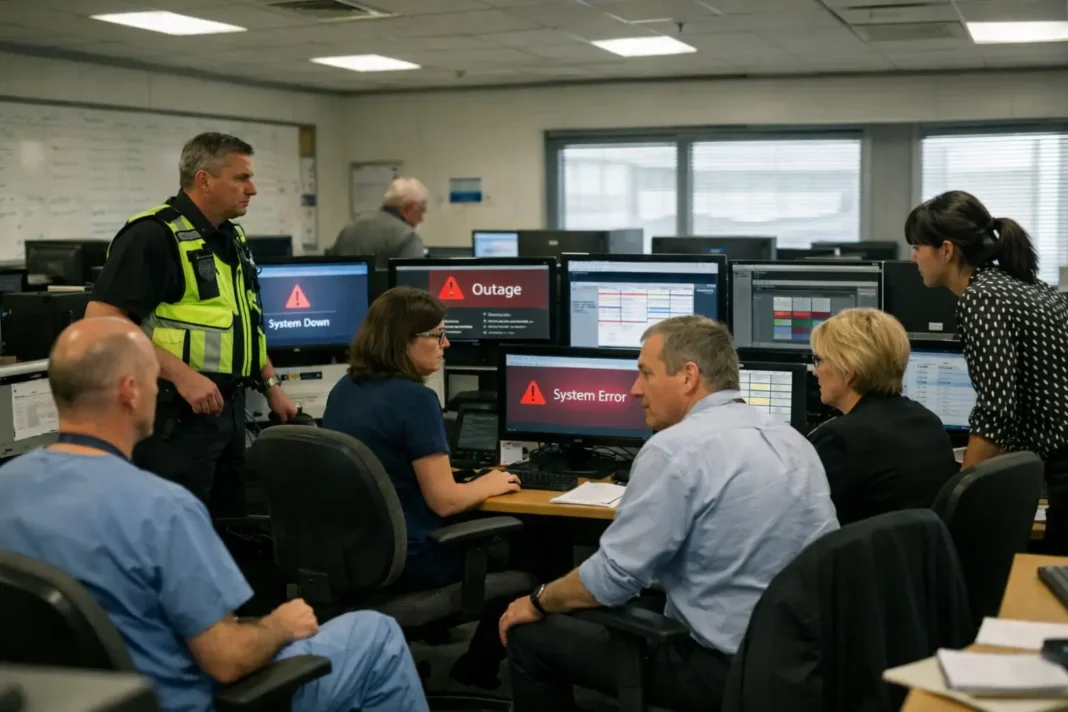
A Microsoft outage has affected parts of the UK’s public sector, with disruption reported across the National Health Service, schools and police forces. The incident has placed renewed attention on the reliance of essential services on large technology platforms, especially where day-to-day operations depend on access to shared digital systems. Microsoft is one of the main providers of workplace tools and cloud services used by public bodies and private organisations across the country.
The impact has not been uniform. Major airports have not been affected, and intelligence services are also understood to be operating without disruption. That distinction is significant because it suggests the outage has not produced a single, system-wide failure across all critical national infrastructure. Instead, the consequences appear concentrated in organisations and services that rely on the affected Microsoft environment for administrative, operational or communications functions.
The UK Government is still assessing the scale of the disruption. For public services, that assessment is important not only to measure immediate operational pressure but also to understand whether contingency arrangements worked as intended. In sectors such as health, education and policing, even temporary loss of access to digital tools can complicate routine coordination, staff communications and the handling of information, although the precise effects differ from one organisation to another.
The episode comes at a time when resilience in digital infrastructure has become a central issue for the United Kingdom. Public bodies have expanded their use of cloud-based software to improve efficiency and standardise access across sites, but that shift also means outages can be felt quickly across multiple institutions. The fact that schools, health services and police forces were all affected illustrates how a technical failure in a widely used platform can move beyond the technology sector and touch core public functions.
Further clarity will depend on the government’s continuing review and on technical information from the organisations involved. For now, the confirmed picture is one of disruption across several public services, while other sensitive and transport-related operations remain unaffected. The priority for authorities will be to restore normal service where needed and to establish whether additional safeguards are required to limit the impact of similar incidents in future.