



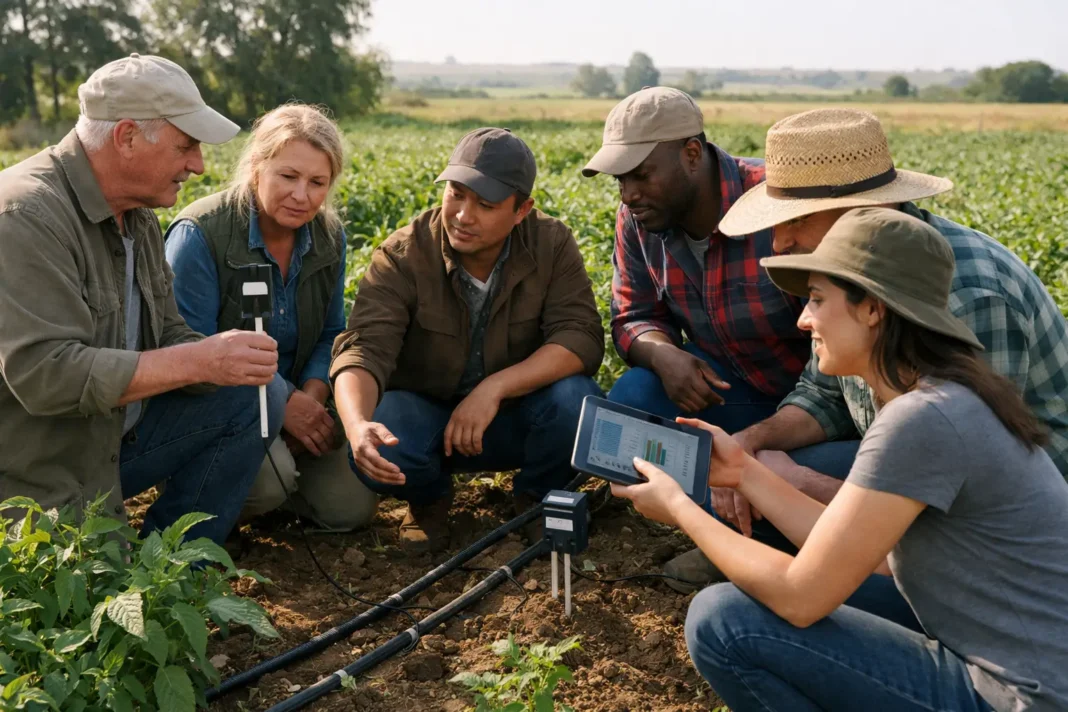
Social relationships are emerging as a crucial but insufficiently documented factor in the spread of climate-oriented farming solutions. A study published in Frontiers in Sustainable Food Systems finds that agricultural research frequently refers to partnerships, networks and institutional collaboration, yet rarely explains how these connections influence the scaling of innovation. The finding points to a gap between recognising cooperation as important and measuring its real contribution to wider adoption.
The issue is central to agricultural innovation because promising techniques do not spread through technical performance alone. Climate-focused practices must move across farms, regions and institutions, often requiring trust, coordination and shared learning among researchers, public bodies, producers and support organisations. When studies mention collaboration without analysing its role, they leave unanswered questions about why some initiatives expand successfully while others remain limited to pilots or local projects.
The research highlights a weakness in the way scaling processes are designed and assessed. If social relationships are treated as background conditions rather than as part of the mechanism of change, monitoring and evaluation may overlook factors that shape outcomes. This matters for climate adaptation in agriculture, where innovations often need to be adjusted to local realities and sustained over time. Understanding who cooperates, how decisions are made and which institutions enable continuity can affect whether an intervention becomes durable beyond its initial setting.
The study does not dispute the importance of partnerships already visible in climate-oriented agricultural research. Instead, it draws attention to the lack of explicit documentation linking those partnerships to scale. That distinction is significant for funders, research organisations and policy makers seeking to improve programmes in sustainable food systems. Better evidence on social dynamics could help refine project design, clarify responsibilities and make evaluations more useful for future interventions, especially where agricultural systems face growing pressure from climate change.