



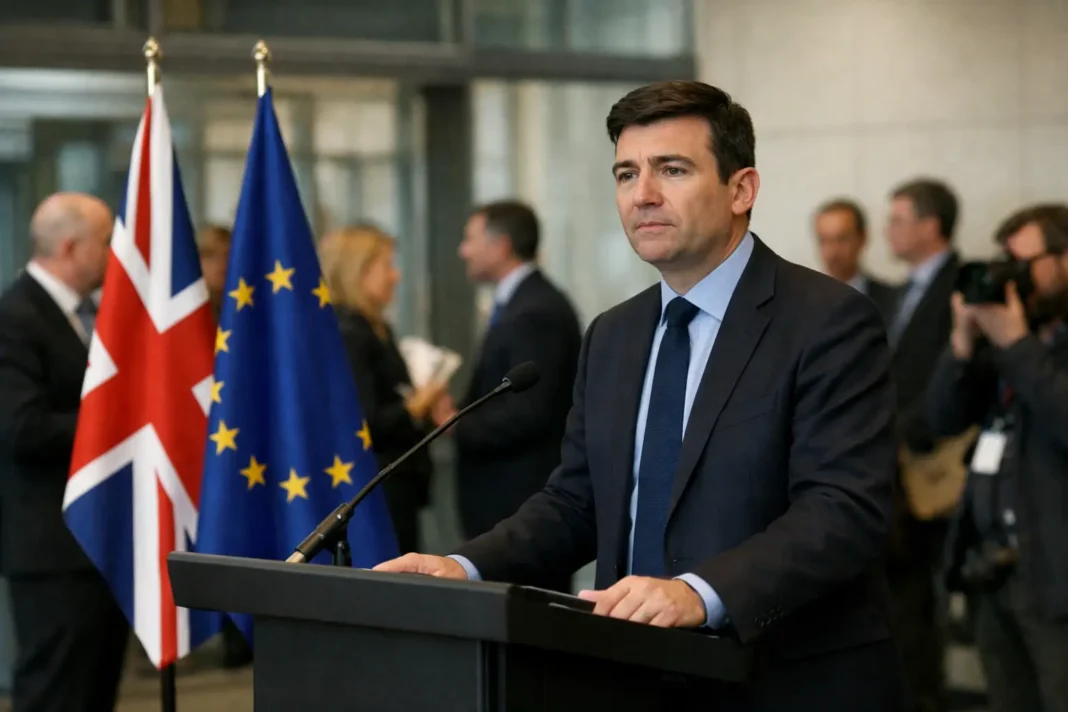
Andy Burnham’s Brussels visit has turned the future of relations between the United Kingdom and the European Union into a live domestic political test. His first EU-UK summit as prime minister produced agreements on youth mobility, food exports and carbon emissions, giving Downing Street tangible results from a relationship it has promised to improve. Yet the meeting also confirmed that the practical agenda is inseparable from the political legacy of Brexit, an issue Burnham is now trying to reopen without making EU membership itself the immediate question.
In Brussels, Burnham met European Council president Antonio Costa and European Commission president Ursula von der Leyen. The institutional setting matters, but so does party background. Burnham and Costa both come from social democratic traditions and both previously led major cities, Greater Manchester and Lisbon respectively. That alignment may make cooperation easier than during the more confrontational years that followed the 2016 referendum. Official channels through the European Council and the European Commission remain central, but political trust will influence how far technical deals can progress.
The Labour government’s approach builds on the earlier reset launched under former prime minister Keir Starmer, when then-business secretary Peter Kyle and Commission vice-president Teresa Ribera moved the two sides toward closer trade cooperation. Ribera, from Spain’s Socialist Workers’ Party, also sits within the wider European centre-left family that Labour has watched closely in recent years. Burnham is using that network while arguing that previous Conservative governments did not secure satisfactory post-Brexit arrangements. The argument reaches back to the centre-right’s own European tensions, including David Cameron’s 2009 decision to leave the European People’s Party, a move that strained relations with influential figures such as Angela Merkel before the referendum negotiations.
For Burnham, the larger challenge is not only in Brussels but in Westminster and in Labour’s electoral map. He has framed his aim as dealing with the consequences of Brexit rather than overturning the referendum result. That distinction is politically important in northern England and the Midlands, where Labour holds seats vulnerable to Reform UK. At the same time, a more open discussion of Brexit’s costs could appeal to voters otherwise drawn to the Liberal Democrats or the Greens. Kemi Badenoch and the Conservatives also face the difficulty that criticism of their handling of Brexit can come from both Leave and Remain voters.
The summit therefore marks the beginning of a more complex phase rather than the conclusion of a reset. Burnham was outside the Westminster frontline during the most turbulent Brexit years, serving as mayor of Greater Manchester, which gives him room to address the issue with less personal baggage than some predecessors. But his own Makerfield constituency voted heavily to leave the EU, underscoring the balance he must maintain. The agreements reached in Brussels may ease specific frictions, but the durability of the UK-EU thaw will depend on whether Burnham can make closer cooperation politically acceptable at home.
