



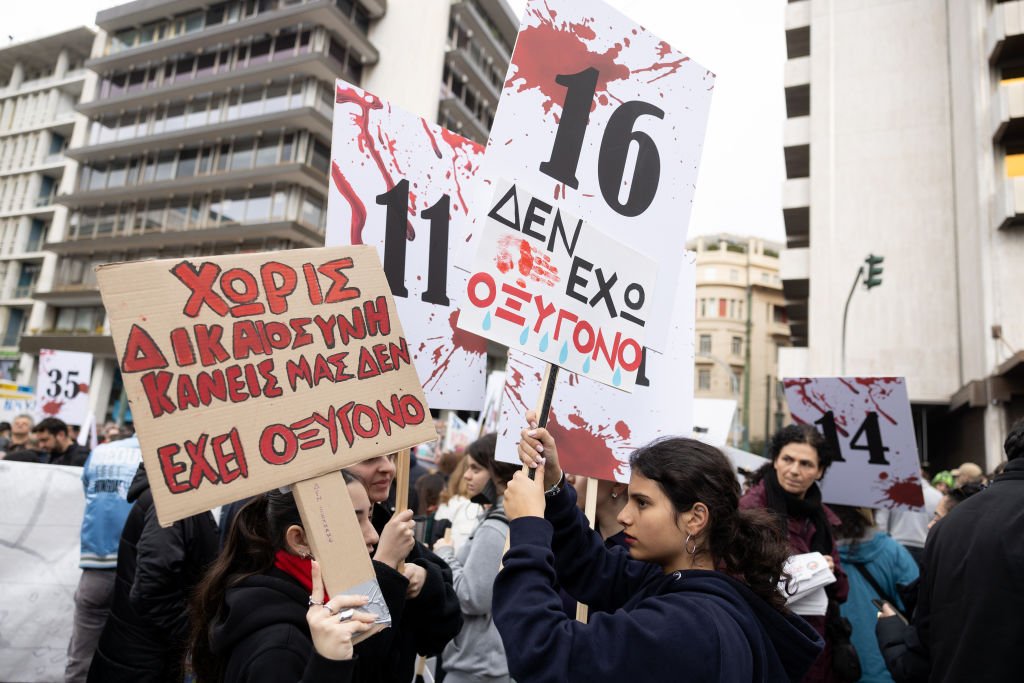
In February 2023, a train crash in Tempi, central Greece, claimed 57 lives, many of them young people. This week the trial finally began to determine who was responsible for the catastrophe. But not only are the victims’ families doubtful that justice will be served – the role played by EU institutions is also being overlooked.
The tragedy might have been avoided had an EU-funded contract, signed in 2014 to reconstruct and upgrade Greece’s railway signalling and remote control systems, been implemented.
Though the shortcomings of Greece in maintaining its railway system have been widely reported, the European Commission’s position remains unclear. The EU Public Prosecutor, Laura Kövesi, had already launched an investigation prior to the accident, after identifying irregularities within the contract.
In an interview with Euractiv, Kövesi questioned how it was possible that no one had detected that something was amiss.
“It led us to ask how these issues went unnoticed. Throughout the lifecycle of the project, there were a number of irregularities and concerns, yet none were reported – neither at national nor European level, nor by the managing authority, auditors, oversight bodies, or other institutions,” she said.
Kövesi did not single out any particular institution. When asked about the Commission, she replied that the EPPO had not received any report.
When Euractiv asked the Commission whether it had identified or reported the irregularities in the contract, we received no response.
A legitimate question, therefore, is whether the EU officials responsible for overseeing the contract in DG REGIO are still in position or have since been replaced.
Furthermore, why did DG MOVE fail to take action against Greece after identifying, in 2019, the absence of a permanent, independent railway accident investigation body as a breach of EU law?
This leads to the most pressing question of all: are Eurocrats ever held to account?
The EU can call for fighting corruption in member states, but setting your own house in order should take priority before lecturing others.
Roundup
Iran hits Eurozone business – Eurozone business activity slowed to its lowest level in almost a year this month as fears grow that the Iran war will curb growth and entrench high inflation in the European economy. “The flash Eurozone PMI is ringing stagflation alarm bells as the war in the Middle East drives prices sharply higher while stifling growth,” said one business economist.
Farmers raise concerns with EU-Australia deal – “Agriculture has been, once again, centre stage in this entire negotiation,” a senior Commission official told reporters on Tuesday morning, after Brussels’ latest trade agreement was secured. Beef and mutton, sugar and feta are particularly sensitive points.
Hezbollah links to wave of antisemitic attacks investigated – European security agencies are investigating a wave of attacks on Jewish targets across the continent claimed by a previously unknown militant group, raising concerns about possible links to networks aligned with Hezbollah.
Across Europe
Frederiksen fractures the right – The once formidable blue bloc of Denmark’s right has lacked a clear direction since 2022, when the centre-right Liberals broke ranks to form a centrist coalition with Frederiksen’s Social Democrats. The fragmentation is reflected in polls as Danes elect a new parliament.
Slovakia ‘discriminatory’ diesel pricing triggers Commission – The Commission has signalled it is ready to act against Bratislava over a system charging foreign drivers more for diesel than Slovaks, echoing its 2022 move against Hungary over a similar measure. Commission spokesperson Ricardo Cardoso said on Tuesday that they had taken note of the new measures and described them as “highly discriminatory and against EU law”.
Greek minister warns of Iran nuclear threat – “Could anyone in Europe rest easy at night if the regime in Iran possessed nuclear weapons?” asked Greek health minister Adonis Georgiadis in an interview with Euractiv. Georgiadis reviewed the geopolitical challenges facing Europe, and highlighted inconsistencies in foreign policy positions.
Source:
www.euractiv.com

