



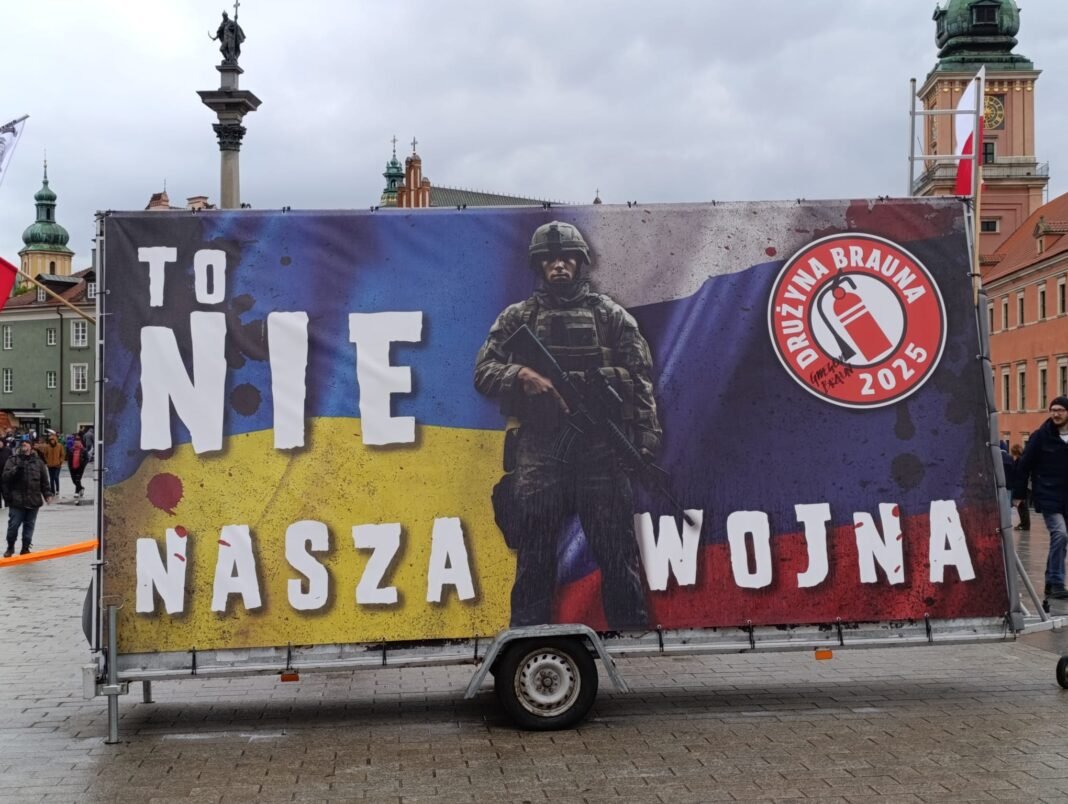
WARSAW – Poland remains one of Ukraine’s staunchest supporters in Europe but a growing row over wartime history is accelerating a broader shift in which Ukraine has become an increasingly divisive issue in Polish politics.
The latest rupture came after President Karol Nawrocki stripped Ukrainian President Volodymyr Zelenskyy of the Order of the White Eagle, Poland’s highest state honour.
The move triggered a diplomatic backlash, with several senior Ukrainian officials relinquishing their own Polish awards, including presidential aide Kyrylo Budanov and former presidents Leonid Kuchma and Viktor Yushchenko.
The row erupted in May, after Zelenskyy approved the naming of a military unit after the “Heroes of the Ukrainian Insurgent Army” (UPA). During World War II, the UPA killed an estimated 100,000 Poles in Volhynia and Eastern Galicia.
While widely regarded in Poland as responsible for genocide, the UPA remains for many Ukrainians a symbol of resistance against Soviet rule.
“Ukraine’s struggle to defend its statehood against Russia has reinforced the demand for anti-Russian national myths,” said Łukasz Adamski, director of the Mieroszewski Centre, a state-funded institution focused on Eastern Europe. Yet Adamski argues that Ukrainian elites underestimate the impact such memory politics has on relations with Poland.
“Even if the intention is to advance an anti-Russian narrative, the heroification of formations responsible for genocide is bound to provoke strong opposition within Polish public opinion,” he said, arguing that in practice, it narrows the space for Polish politicians to manoeuvre politically.
‘From one extreme to another’
The controversy has quickly spilled into domestic politics.
When Deputy Higher Education Minister Andrzej Szeptycki said in an interview with TOK FM radio that the UPA had fought for Ukrainian independence and was “something like Ukraine’s Cursed Soldiers” – a reference to anti-communist Polish partisans who resisted Soviet domination after World War II – the backlash was immediate.
Przemysław Czarnek, a leading figure in the national-conservative Law and Justice (PiS) party and a potential prime ministerial candidate for the 2027 election, questioned Szeptycki’s loyalty.
“I demand a suspension of parliamentary proceedings until it is explained why this government still employs pro-Ukrainians who insult Poles,” he told parliament.
Many politicians criticised what Donald Tusk , the prime minister described as increasingly radical anti-Ukrainian rhetoric. Yet even some of those warning against it have adopted a tougher tone themselves, reflecting what commentators describe as a shift “from one extreme to the other”.
At the start of Russia’s full-scale invasion, Poland was widely regarded as Ukraine’s most steadfast ally. The then Law and Justice government spoke of a near “national brotherhood” between the two countries, while some figures in PiS-linked circles floated ideas of a Polish-Ukrainian union forming the core of a “New Three Seas” bloc capable of balancing German and French influence within the EU.
“Now virtually the entire political spectrum is competing over increasingly anti-Ukrainian rhetoric,” said political commentator Jakub Majmurek said.
Growing scepticism
Poland’s support for Ukraine since 2022 has been extensive.
According to estimates from the Prime Minister’s Office, military equipment transferred during the first year of the war alone was worth PLN 7.23 billion (€1.7 billion), excluding other forms of military assistance.
Warsaw also played a leading role in supporting Ukrainian refugees and advocating for Kyiv’s EU candidacy. “Poland supports the fast-track path to Ukraine’s membership in the European Union,” then-president Andrzej Duda said in February 2022.
The shift in attitudes is partly linked to the run-up to the next parliamentary election, scheduled for October 2027, where Ukraine is expected to feature prominently.
“Even without the controversy over the UPA, this would still be the case,” Adamski told Euractiv. “The Ukraine question has become a factor in Poland’s domestic politics, not least because more than one and a half million Ukrainians live in the country.”
Public opinion too appears to be hardening. A CBOS survey found that 43% of Poles now hold unfavourable views of Ukrainians, compared with 29% expressing sympathy. In 2023, the figures were almost reversed, with 51% expressing sympathy and 17% hostility.
Research published by the University of Warsaw in early 2025 points to growing criticism of Ukrainians living in Poland. Respondents cited what they perceived as a sense of entitlement among some Ukrainians, arguing that they expected social benefits while showing insufficient gratitude for the assistance received. Others pointed to what they described as a lingering “Soviet mentality”.
“It creates a feedback loop,” Majmurek said. “The more politicians play the anti-Ukrainian card, the stronger anti-Ukrainian sentiment becomes. And the stronger that sentiment grows, the more reluctant politicians are to push back against it.”
(cs,bw)
Source:
www.euractiv.com