



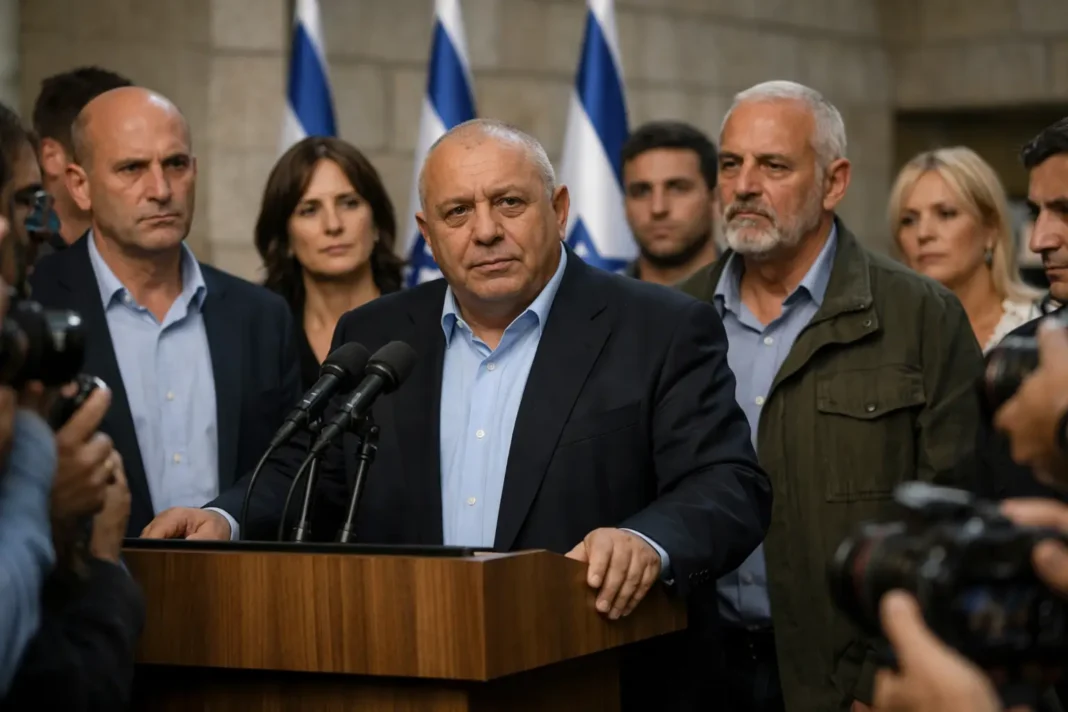
Gadi Eisenkot now faces the most difficult test of his short political career: turning an anti-Netanyahu parliamentary bloc into a viable government. President Isaac Herzog has given the former military chief 28 days to assemble a coalition, with the possibility of a 14-day extension. The mandate follows an inconclusive election in Israel that left both Prime Minister Benjamin Netanyahu and his rivals without a clear route to a majority.
Netanyahu’s Likud emerged from the October 27 vote with the largest number of seats, but his camp did not reach the 61 seats required in the 120-member Knesset. Eisenkot’s side also fell short. That arithmetic gives exceptional weight to the two Arab-majority parties, the Joint List and Ra’am, which together won 19 seats, their strongest combined showing. Their parliamentary strength could help resolve the deadlock, but it also exposes the political limits of any broad coalition built primarily around opposition to Netanyahu.
Eisenkot’s potential partners include his Yashar party, Naftali Bennett’s B’Yachad, Yair Golan’s Democrats and Avigdor Liberman’s Yisrael Beytenu. Such an alliance would be ideologically diverse even before any support from Arab parties is considered. During the campaign, several figures in the anti-Netanyahu camp ruled out entering a coalition with Arab parties, making any formal arrangement politically costly. Ra’am has indicated it would back an Eisenkot-led government, but Israel’s recent history offers a warning: in 2021, Ra’am joined Bennett’s coalition, a breakthrough that lasted only about a year before the government collapsed.
The debate also touches deeper questions about the state’s democratic structure. Israel’s 2018 Nation-State Law defines national self-determination in Israel as unique to the Jewish people, a framework that complicates the role of Arab parties representing Palestinian citizens of Israel in supporting a governing coalition. At the same time, ultra-Orthodox parties such as Shas and United Torah Judaism remain pivotal actors. Their opposition to compulsory military service for ultra-Orthodox Jews has already created deep political divisions and could shape negotiations again.
Any new government would take office under severe pressure. The election was the first since the October 7, 2023 attack by Hamas and the war in Gaza that followed. Violence in the West Bank, uncertainty over regional security and a changing political environment in the United States would test even a cohesive cabinet. Eisenkot, who entered politics in 2022 and founded Yashar only last year, must now prove that a coalition assembled from mistrust, necessity and narrow numbers can govern as well as survive.