



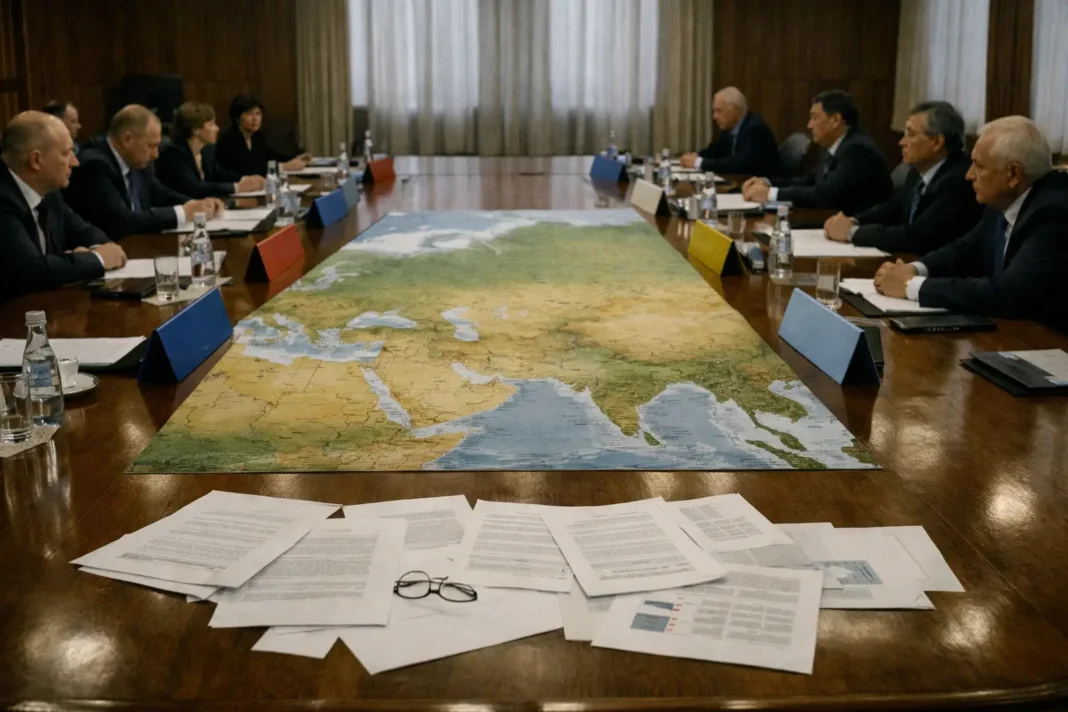
Russia’s latest push for a new continental security order has moved into the diplomacy surrounding the war in Ukraine, but the proposal faces obstacles that go far beyond the battlefield. During recent talks in Abu Dhabi involving Russian, American and Ukrainian negotiators, Moscow revived its demand for a redesigned security framework covering Europe and Asia. Donald Trump has appeared receptive to a broader settlement involving Europe, while Russia’s Foreign Ministry has outlined a much wider vision through remarks by Sergey Lavrov.
In a recent address at a security conference in Minsk, Lavrov argued for a Eurasia-wide arrangement built around sovereignty, equality and what Moscow calls indivisible security. He repeated Russia’s longstanding claim that NATO expansion created the conditions for the current confrontation, and accused Western governments of pursuing a similar military-political structure in Asia. The proposal leaves many practical questions unanswered, including who would participate, how decisions would be made and how such a system would coexist with existing alliances and institutions.
For most European governments, the central problem is political trust. Russia is widely treated as the continent’s main security threat after its full-scale invasion of Ukraine, making any Russia-led or Russia-shaped framework difficult to accept. Moscow has also resisted meaningful European participation in peace negotiations, which weakens the case that European capitals would have real influence over any wider settlement. Debate inside Europe is not uniform, however. Economic pressure and the rise of populist parties have complicated consensus in some countries, including Germany, where the Alternative for Germany opposes military and financial support for Kyiv.
Asia adds another layer of complexity. China has its own approach to global order, built around non-interference, state sovereignty and major economic projects such as the Belt and Road Initiative. Although Beijing and Moscow have deepened cooperation, they also operate in overlapping spaces, especially Central Asia, where Chinese influence has grown in a region once dominated by Russia. A credible Eurasian security framework would therefore have to accommodate Chinese priorities rather than simply extend Russian preferences across the continent.
The broader region is already dense with institutions and alignments, from the Organization for Security and Co-operation in Europe to the Shanghai Cooperation Organisation, BRICS and Gulf structures. Many Asian states also prefer flexible partnerships or non-alignment instead of binding blocs. Russia’s proposal reflects a wider erosion of the post-war security order, but replacing that order would require broad consent among states with diverging interests. At present, the gap between Moscow’s design and the strategic choices of Europe and Asia remains substantial.
