



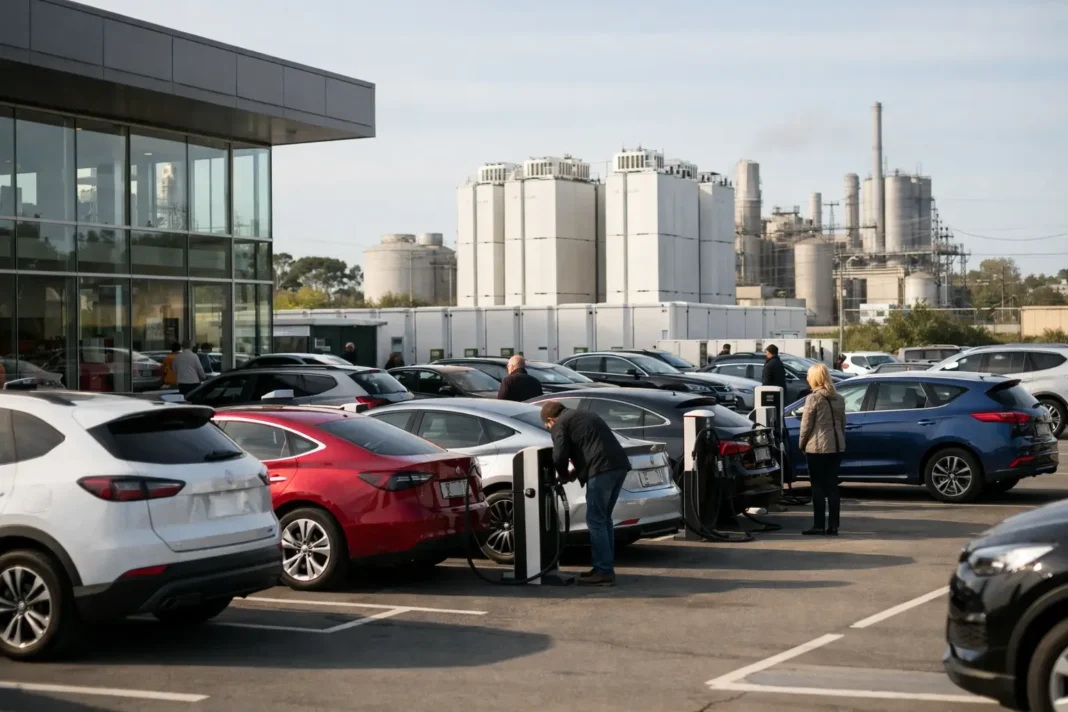
BYD’s rapid ascent has reshaped the landscape of Australia‘s new-car market as consumers shift away from petrol amid volatile fuel prices. Demand for electric vehicles jumped in 2026, with EVs accounting for a significant share of sales in the first half of the year, and one Chinese manufacturer has moved quickly to capture that demand.
BYD began as a battery maker in the 1990s and evolved into an automaker by the mid-2000s. Its strategy emphasizes in-house production of batteries, electric motors and key electronics, reducing dependence on external suppliers. The company’s adoption of lithium iron phosphate cells, known commercially as the Blade Battery, and a broad model mix that includes plug-in hybrids alongside full BEVs form part of its industrial approach. BYD also controls logistics for some exports, operating its own transport capacity to reach distant markets.
Global sales data show how quickly the company scaled: dozens of thousands of units in 2020 grew to several million by 2025, with fully electric deliveries alone numbering in the millions. In the Australian market BYD has been a top seller, reporting tens of thousands of vehicles in the first eight months of 2026 and overtaking established names in the local EV segment. The brand reduced the gap with Toyota for overall monthly volumes in mid-2026 and surpassed Tesla in electric-vehicle brand sales over the same period.
The company’s expansion has prompted scrutiny. Market access to the United States remains restricted by tariffs and national-security concerns, and Australian observers have raised questions about cybersecurity after a media investigation demonstrated remote access to some vehicle functions. Safety testing awarded high ratings to certain models but also noted concerns related to vehicle mass and front-end design. ANCAP highlighted penalties in assessments tied to those characteristics.
The broader consequence is a rapid shift in the global auto order as manufacturers from China move into markets long dominated by Japanese, European and North American marques. State support for electrification and a vertically integrated manufacturing model helped BYD scale quickly. If current trends hold, the composition of cars on Australian roads is likely to change substantially over the coming decade, with implications for dealers, service networks and regulators alike.

