



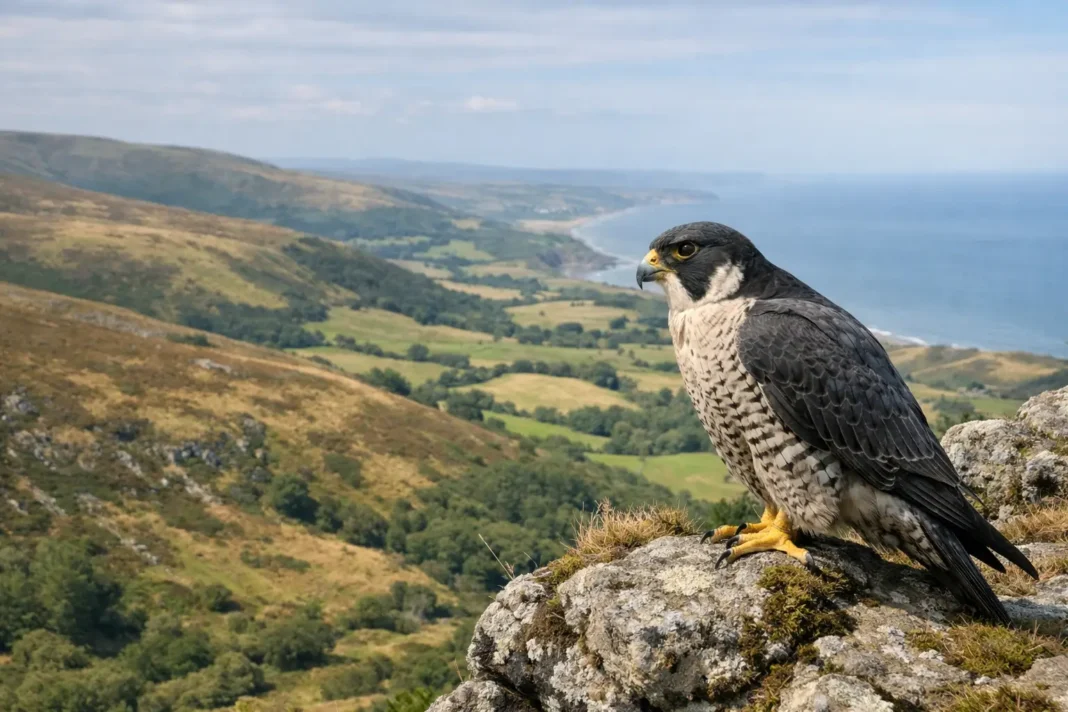
Britain’s warming climate could make the country more hospitable to the peregrine falcon, the fastest animal on Earth in its hunting dive. A new study indicates that areas suitable for the species in the United Kingdom could expand by 74% by 2080 if global emissions remain high. The finding points to one of the more uneven ecological effects of climate change: some species may gain potential range even as others lose viable habitat.
The result does not mean peregrines are guaranteed to spread across every newly suitable area. Habitat models identify places where climate conditions may become more favorable, but the presence of a species also depends on nesting sites, prey availability, human disturbance and the ability of birds to establish territories. Peregrines already use a range of environments, from natural cliffs to quarries and city structures, which may help explain why future conditions could open additional space for them in Britain.
The study’s projection is tied to a high-emissions pathway, a scenario in which greenhouse gas output remains substantial through the century. Such pathways are widely used in climate science to test how ecosystems may respond under different levels of warming, including assessments by the IPCC. In this case, the projected expansion underlines the importance of separating climate suitability from overall conservation outcome: a warmer Britain could create opportunities for one predator while increasing pressure on other parts of the food web.
For conservation authorities and wildlife managers, the finding adds a practical question to long-term planning. If peregrines begin using new areas, monitoring may need to cover regions not traditionally associated with the species. Protection of nesting locations, management of disturbance during breeding periods and assessment of prey populations would remain relevant even where the climate becomes more favorable. The potential expansion also illustrates why biodiversity policy increasingly relies on forward-looking maps rather than only on current distribution.
The broader message is not that warming is beneficial for wildlife. Climate change is reshaping habitats in different directions, creating possible winners and losers within the same landscape. The peregrine falcon’s projected gain in suitable British territory by 2080 is therefore best read as a sign of ecological reorganization, not a reassurance. Even for a highly adaptable raptor, future abundance will depend on more than temperature alone.