



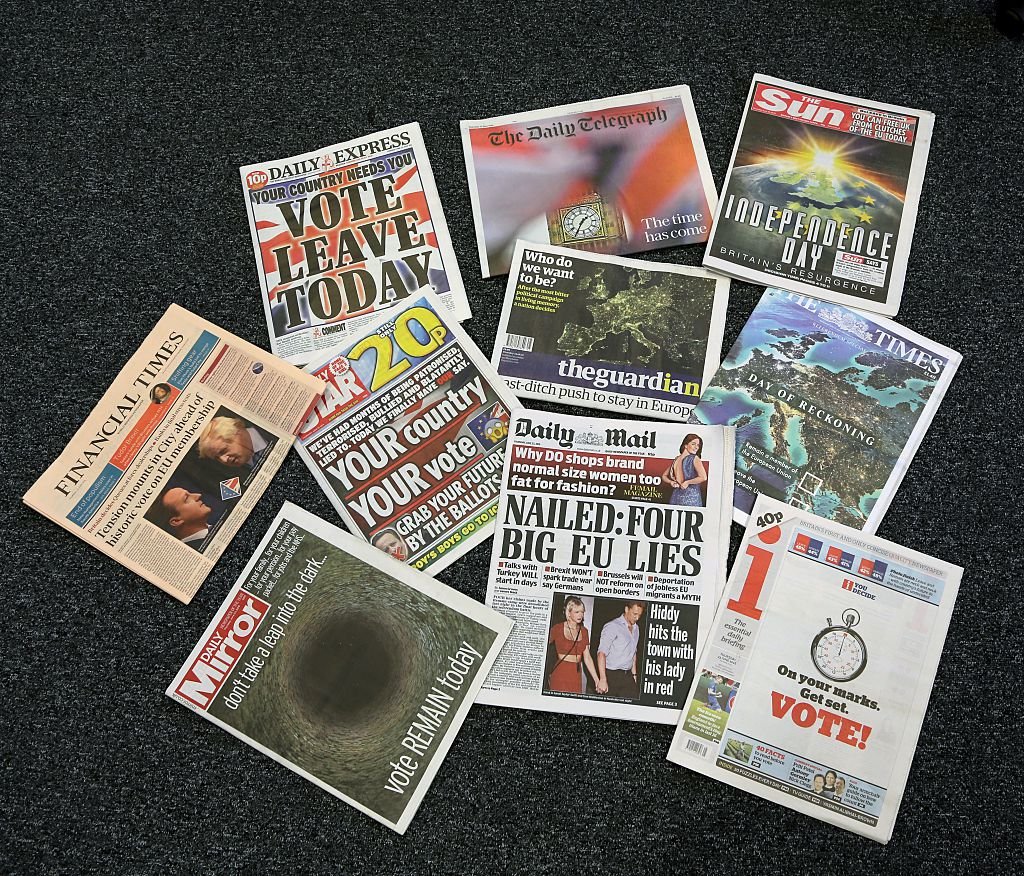
The meaning of Brexit and its enduring impact on British politics, as evidenced by the pending departure of Keir Starmer, was its profoundly constitutional character.
The vote asserted a central principle in British politics: that institutions of authority and policy should be representative of the public and subject to accountability through democratic elections.
The question of how politics is constituted – who decides – is still the wider European question posed by that fateful referendum on 23 June, 2016 and the rise of populism.
As the results of the British referendum became clear in the early hours of 24 June, an electrical storm raged over Brussels while a giant thundercloud, illuminated by lightning, loomed above the Berlaymont – an augury of the political turmoil ahead.
‘End of history’
There was a context to the referendum.
The early 21st century – in a Britain defined by the leadership of Tony Blair and his “New Labour” government – saw the dawning of a brave new world shaped by international markets, globalisation and the EU.
Nations and national feeling were increasingly seen as obstacles to be removed. The future was bright, and resistance seemed futile.
Building on Margaret Thatcher’s labour and economic reforms, which she famously described through the acronym TINA (There Is No Alternative), Blair personified a teleology born of Francis Fukuyama’s “end of history” thesis, manifested in a benign technocracy.
‘Slow to complain’
As Blair told his already restive Labour Party in 2005, “the character of this changing world is indifferent to tradition”.
“No respecter of past reputations. It has no custom and practice,” he said. “It is replete with opportunities, but they only go to those swift to adapt, slow to complain, open, willing and able to change.”
Simmering discontent came to a head in 2005 with referendums scheduled across Europe on the proposed EU Constitutional Treaty. The Dutch and French voted no. Other votes, including a referendum in Britain, were cancelled.
The Lisbon Treaty, more or less identical to the rejected Constitutional Treaty, had emerged by 2007 with a pact not to put it to popular votes unless absolutely required by national constitutions.
As French President Nicolas Sarkozy told a private meeting in Brussels, “There is a cleavage between people and governments. A referendum now would bring Europe into danger.”
Pressure was building. Senior British officials, including Kim Darroch, the UK’s permanent representative to the EU, admitted that the Europe created by the Lisbon Treaty differed significantly from the European Economic Community Britons had voted to join in 1975.
Crisis
Meanwhile the 2008 financial crisis unfolded – a devastating series of economic events that are still shaping Britain and outer European countries.
Unusually for a global economic crisis, there was no rethink of the model for national economies and all political sinews were strained to preserve the old order, bringing in turn a series of sovereign debt crises as fiscal policy became the objective of preserving senior bank debt, insulating financial institutions.
“Alternativlos,” said Angela Merkel, then the EU’s most powerful figure – that is to say, “without an alternative.”
In December 2011, there was a major summit crisis when David Cameron, the British prime minister, used his national veto to block an emergency eurozone treaty after asking for safeguards to defend the City of London from measures taken to preserve the euro.
The resulting row, and bypassing of the UK, set in motion Cameron’s strategy of seeking a renegotiation of EU membership in 2015 and putting what would be billed as a new relationship to a referendum.
Meanwhile other trends became entrenched alongside the austerity that followed the bailouts of financial institutions and the euro itself.
In Britain, asset wealth has surged while wage growth has stagnated. According to OECD figures, between 2000 and 2008, average wage growth stood at 1.7% annually. Between 2008 and 2025, it fell to 0.6%. At that rate, wages would take 109 years to double in value, compared with 43 years previously.
This statistic is arguably more significant than the 4% of productivity growth that Britain is estimated to have lost since Brexit.
As Liam Byrne, a senior Labour MP, put it: “asset wealth has surged while wage growth has stagnated… The result is not simply inequality of wealth. It is inequality of progress.”
Britain’s economy, its commonwealth, no longer works for most people.
Borders
Britons voted on EU membership against the backdrop of a migration crisis that exposed weaknesses in Europe’s external borders.
Millions entered the EU, including refugees and irregular migrants, often with limited identity checks. Among them were operatives and funds linked to the Islamic State cells that later carried out attacks in Paris and Brussels. Those who complained were dismissed as xenophobic or anti-immigrant.
After Brexit, migration became one of the defining political questions facing the EU, raising broader concerns about whether European institutions were responsive to voters.
As the UK fought its culture wars and got through six prime ministers, the EU witnessed the rise of populist parties appealing to voters on the basis that political policies should not be, as Merkel put it, “alternativlos’.
In both Brexit and the rise of European populism, the underlying argument was that political institutions should reflect voters’ preferences and respond to their concerns. Far from being an expression of British exceptionalism or imperial nostalgia, Brexit reflected political trends visible across Europe.
As Michel Barnier, the French statesman who negotiated Britain’s exit, explained in 2021, the same political conditions apply across Europe – including in France. “They say the EU did not respond to legitimate desires of citizens, there is social unrest or anger,” he said. “Europe is also often criticised for its red tape and complexity.”
Rejoin?
The prospect of Britain rejoining the EU remains remote.
Any future British government – even one led by Andy Burnham – would first need to convince voters that political institutions serve their interests and remain accountable to them. That remains unfinished business a decade after the referendum.
Any future accession process would also need to address the question at the heart of Brexit: who exercises political authority and how that authority is constrained. Britain left the EU through a referendum and, politically at least, would likely require another popular vote to return.
Perhaps the best bet would be for the EU to sort Europe’s wider crisis on political representation and populism. Do not hold your breath.
(jp, vc, cs, ow)
Source:
www.euractiv.com